
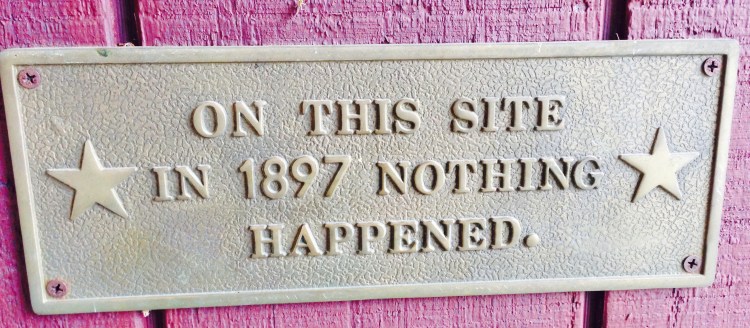
A few years ago, I walked into someone’s office and noticed the following quote:
“When nothing happens, nothing happens.”
I don’t know who this quotation should be attributed to with any certainty. Maybe someone will tell me someday. At the time, I didn’t think too much about it. A sort of “Deep Thoughts” by Jack Handey moment if you remember that reference from Saturday Night Live. At some point later, it dawned on me that there was actually some profound truth here.
Fast forward to a few weeks ago, during a discussion around the context of COVID-19, and dealing with our current VUCA environment:
“Famous last words: maybe it will go away on its own.”
In thinking about these two quotes, I realized that while there is a lot that is going on right now that is certainly uncontrollable, there is much we can do to continue to drive our own Agile Best Self journeys. Many, or maybe all, of the 12 Agile Best Self Principles can guide us here. I was taken by something interesting, though, as I looked at Principles 5 and 6.
Agile Best Self Principle #5: Create a best self environment of motivation, trust, and support for yourself and others.
Agile Best Self Principle #6: The most effective way to be your best self is to be mindful and intentional.
Looking at these two principles together for a moment: it looks like we have a chicken and egg problem. Which do we need first in order to move our own journeys forward? Do we need a supportive environment before we can be mindful and intentional about moving our journey forward? Or, is it the other way around?
According to Martin Fowler’s recollection of the Snowbird meeting where the Agile Manifesto was created, the focus of the sessions were primarily on the manifesto itself, and the principles were largely finalized after the meeting. It is believed that the only principle that the attendees all agreed upon was the first principle — our highest priority is to satisfy the customer through early and continuous delivery of valuable software. So, it is often implied that the first principle is the cornerstone principle and the other 11 follow it, in no particular order. Notice they are not numbered on the Agile Manifesto site. They are often numbered when they are documented elsewhere to make it easier to reference in conversation.
It was our intent that the 12 Agile Best Self Principles should be thought about in the same way when we drafted them for the first time. Principle 1 is the cornerstone, and the other eleven get their energy from it. Numbering the principles does not put a relative priority of one over the other. We don’t have to have a sequential checklist mentality about them. They are meant to be applied, and combined, as the user sees fit.
After that short detour, let’s get back to the chicken and egg problem I uncovered as I was trying to apply Principles 5 and 6. The answer to which one comes first is, of course, it depends!
What works for me may not resonate for you, or anyone else. When I think about my Agile Best Self journey, it is really important to have intention. Intention flows from my North Star (“Be a Light”), and sounds something like:
I can “Be a Light” by…
or
I can be most authentically me in this situation by…
To further pick this apart, Principle 6 also talks about mindfulness, which we know is a skill that allows us to develop awareness of our thoughts or our internal narrative from an outside-in perspective. This then creates the opportunity to process that thought through one of the statements above. This sets an intention that reflects the most authentic version of you (your best self!) in that situation. One story about this thought process is found in one of my previous posts. In that post, I detect the inner critic at work, and quickly reset the narrative through mindfulness. All of the time spent doing mindfulness exercises paid off in that story, and continues to pay me back every day.
Building the habit of routinely and mindfully applying intention will create the foundation you need. Building that meditation foundation is an example of what we mean in Principle 5, which is the best self support environment for yourself. Add Principles 4 and 11, and you suddenly find that you have a strong support structure to help you pursue your best self.
Agile Best Self Principle #4: Engage your trusted circle daily.
Agile Best Self Principle #12: At regular intervals, reflect on how to become your best self, then tune and adjust.
It’s my sense that everything comes together and you get maximum traction once your North Star is established. If have built a habit of intentionally applying your North Star, you will naturally be drawn to those who will support and energize you — loved ones, close colleagues and friends. The Agile Best Self community of like-hearted people has become that support system for me over the past year. With Michaele as my partner, I have had the good fortune to share the Agile Best Self journey to people all over the world.
Remember the quotes about around inaction above? Regularly applying Principle 6 also means that being mindful and intentional is an action — a choice to show up authentically as your best self.
Last week, I was informed that I was going on furlough at work, in the midst of everything that was going on, this provoked a lot of fears and uncertainty. One of the conditions of the furlough was that I had to completely detach from work, and not access systems or do company work at any time. When I shared this story with Michaele, the conversation quickly turned to how this time could be used. The thought process was the same as I described – applying Principle 6 to set an intention, then applying my North Star in the current reality to craft a path forward. What came out of it was a commitment I made to myself and Michaele to do a significant amount of writing — 10,000 words in ten working days. I’ll get back to you to tell you how I did. Given the current reality, this was probably the best thing I could do to move my own journey forward, which sharing insights about Agile Best Self to the world. Something good will happen, and I am not just wishing my reality would just go away. It starts with intention.
Applying this narrative to the current COVID-19 reality means you are taking action on your controllable reality. You are becoming a better version of you than you were before. Although not immediately apparent, lots of things are happening, and you have control of many of those “things”. Hoping things “go away on their own” is not an option when intentionally building a best self life. Follow your North Star to make something good happen. We all need this in a world where there is so much uncertainty.
Copyright © 2018 – 2026 Michaele Gardner and Brian Hackerson


 This website uses cookies to improve your experience while you navigate through the website. Out of these cookies, the cookies that are categorized as necessary are stored on your browser as they are essential for the working of basic functionalities of the website. We also use third-party cookies that help us analyze and understand how you use this website. These cookies will be stored in your browser only with your consent. You also have the option to opt-out of these cookies. But opting out of some of these cookies may have an effect on your browsing experience.