Helping Others vs. Enabling Others

In January 2019, Michaele and I created the 12 Agile Best Self Principles. Since that first version, there have been a number of changes, with more certainly on the way. Our collaborative approach to editing our content has yielded deeper understanding of the principles, and an appreciation of the importance of each word in them.

One of the recent changes was to Agile Best Self Principle 1:

Agile Best Self Principle #1: Our highest priority is to be our best self and enable others to be their best selves.

The original version said “…our best self, so that we can help others be their best selves”. It comes down to the word “help” compared to “enable”. At first look, the difference seems trivial, but looking deeper I feel it’s actually a more important change. The words matter.

Let’s start with the definition of the word help, from Google:

Highlights of the definition are around doing something in service to someone else, be of benefit to, or improve. As I thought about the definition, what resonated with me was that help is primarily like adding an extra set of hands to help someone else.

Now, let’s take a look at the definition of enable from Google:
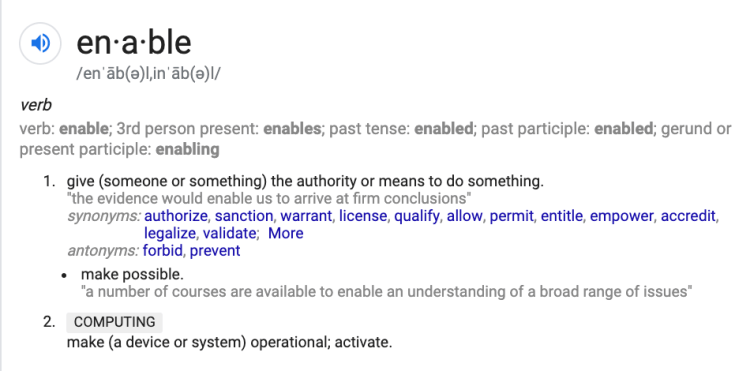
I was surprised at first to learn that the word “help” was not one of the synonyms for enable. Enable has an implication of empowerment, which is different than the word “help”, as stated above.

Helping others can be like a life buoy sometimes

Back to Principle 1. On our journey to our own best self, we will not only ask for and receive help we will also be enabled by others. The second half of the principle is our call to how we apply our best self — to enable others to be our best self. It’s not to say we should not help others, but whenever we can we should strive to enable others. It is like the old saying: “Give a person a fish, feed that person for a day. Teach a person to fish, that person can eat for for a lifetime.”

I experienced this nuance first hand in April 2018, at the Global Scrum Gathering in Minneapolis. At that moment of my journey, I was at the bottom of the emotional roller coaster that goes along with leading a transformational change. I call it the “Pit of Despair”. At that moment, I would have been willing to take any new job that may have come along my way. I went to the event seeking the answer to this question:

“Who is responsible for caring for the coach?”

I was looking for help — I was interested in meeting anyone who could provide a clear answer or solution. I was searching for answers. I was lost until I found myself.

To enable is like giving a guitar lesson

The Agile community enabled me to move forward by showing me that I needed to take responsibility. I had to own it. The Agile community helped me move out of the “Pit” by helping me realize that everything I needed, I already had; I was the one who was best qualified to solve my own problems, moving beyond burnout toward awesome.

In the end, the word “enable” is exactly the right word for Principle 1. To be our best self, we have to put in the time, effort and heartbreak to figure out who that best self is. We have to take that ski jump ourselves.

The words matter, as you can see in Principle 1, and you can be sure we will be mindful of the words as we evolve the 12 Agile Best Self Principles in the coming months.

Copyright © 2018 – 2026 Michaele Gardner and Brian Hackerson

Unleash the Data Geek

Yes, I am a data geek.  I have been into baseball statistics since I was a kid.  I studied Math and Statistics in college, and started out as an actuarial data analyst.  Those that know me well would not be surprised that any application of Agile Best Self Principle 3 would involve analyzing my own data. Gathering data elements daily is an intentional habit.

Agile Best Self Principle #3: Build daily self-care habits.

In my travels as a senior software leader, I came into contact with Chris Dancy, known as the Most Connected Man on Earth.  The lessons he learned and the life changes he made are documented in his book, Don’t Unplug: How Technology Saved My Life and Can Save Yours Too.  I’ve heard him speak of his journey two different times, the second being at our invitation at work in 2015. For those who are not familiar with Dancy, here is a quick lead in from his publisher.  

In 2002, Chris Dancy was overweight, unemployed, and addicted to technology. He chain-smoked cigarettes, popped pills, and was angry and depressed. But when he discovered that his mother kept a record of almost every detail of his childhood, an idea began to form. Could knowing the status of every aspect of his body and how his lifestyle affected his health help him learn to take care of himself? By harnessing the story of his life, could he learn to harness his own bad habits?

Chris Dancy and Brian in 2015

Dancy has taken the idea of quantified self to its extreme and reinvented his whole world.  As a software engineer, Chris created a connected ecosystem that measured just about every aspect of his life with sensors and other data, such as social media data. He was able to hack continuous improvement by leveraging his data to create his best self. He did this by running experiments, collecting data and looking for correlation and causation. The data and the process helped him figure out what habits he needed to change to get the outcomes he desired. For example, changing the color of his credit card helped him use it less often. He tracks decibel levels, air pressure quality, humidity, time spent traveling to the dog park, restaurant visits, menu choices. The list of data elements he tracks is exhaustive and exhausting. However, this is an example of Dancy applying his own interpretation of Agile Best Self cornerstone principle:

Agile Best Self Principle #1: Our highest priority is to be our best self and enable others to be their best selves.

For Dancy to be his best self and true to his values, he wanted to track it all. This detailed measurement and tracking is more than I want to do, but I can apply his concept to my context.

Fast forward a few years — as a Scrum Master, one of the things I learned early was to promote making work visible for my team.  Making work visible to a Scrum team allows better team communication and collaboration.  I think making work visible in the context of building new habits is also important.  In recent months I have been tracking two new things: daily mindfulness practice and daily overall happiness scores.

Tracking these items has created some motivation for real change by simply doing the desired behavior just for the sake of doing it, without expectation of an immediate gain.  This was mentioned by Jeff Warren, a meditation teacher heard in the 10% Happier app (Google Play) and co-author of two meditation books with Dan Harris.  Also, in Daniel Pink’s book entitled When: The Scientific Secrets of Perfect Timing, the author shares a story about the comedian Jerry Seinfeld.  He made a habit of writing comedy material every day, regardless of whether or not he felt inspired to do so.  To track his progress, he used a calendar of an entire year and placed an ‘X’ over the date each day he wrote.  For him, it became about keeping the streak alive. When that streak got long the impact became clear — a whole bunch of new material he could use to keep his act fresh. In the book Atomic Habits: An Easy & Proven Way to Build Good Habits & Break Bad Ones, author James Clear offers a Habit Tracking Template that accomplishes the same thing.

Credit: Atomic Habits: An Easy & Proven Way to Build Good Habits & Break Bad Ones (download, by providing email address)

So, how does this relate to Agile Best Self Principle 3, the principle of building daily habits?  For me, daily habits are much easier to build when the data points are tracked and visible.  Visibility also creates the ability to pair with an accountability partner to help keep you on track.  For the two things I am tracking, daily mindfulness and happiness, I am motivated to capture the data.  I can sustain the data capture because I reduced the friction of data collection. Chris Dancy was able to scale the number of data points he could capture by leveraging his talents as a software engineer combined with clever use of open source platforms, thus reducing friction for data collection and analysis.

Mindfulness tracking is easy.  The built-in functionality of the 10% Happier app does the work for me, with Apple Health to backing me up automatically.  Each time I do my mindfulness activity, I get that immediate feedback from the app that also provides a nice dopamine dose.  The happiness metric is a little more work, but since I need to report it to my Scrum Master, I get two benefits for the effort spent.

Seeing the data and reflecting on what the data trends mean, makes the data collection worth it. I won’t go to the level of Chris Dancy, but that is not the point. My life is my journey, not his. Over time I am confident tracking these data points and making better decisions as a result will help me become my best self.  Benefitting from neuroplasticity and understanding my happiness definitely helps me find my next best version of me, and then the next version, and the next.

Copyright © 2018 – 2026 Michaele Gardner and Brian Hackerson